Magic Johnson Net Worth 2026 - How a Point Guard Became a $600 Million Mogul
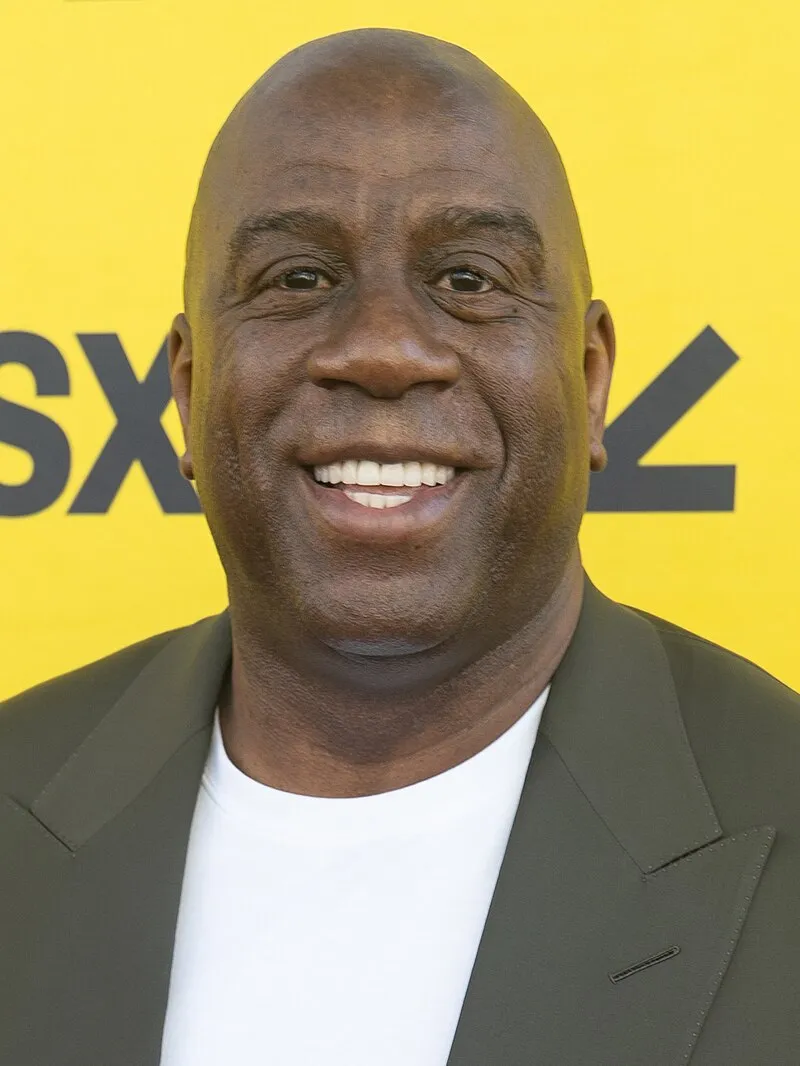
Photo of Magic Johnson, via Wikimedia Commons
Earvin "Magic" Johnson earned roughly $40 million during his Hall of Fame playing career with the Los Angeles Lakers — a figure that now represents a small fraction of his estimated $600 million net worth. Through real estate development, franchise ownership, and a pioneering approach to community-focused investment, Magic transformed athletic celebrity into one of the most enduring business empires in American sports. His story is not simply one of financial success; it is a master class in strategic reinvention.
The Playing Career That Launched Everything
Selected first overall by the Los Angeles Lakers in the 1979 NBA Draft, Earvin Johnson arrived in Hollywood as a 6-foot-9 point guard with a smile as wide as his vision on the court. Over 13 seasons, he won five NBA championships, three MVP awards, and three Finals MVP honors, cementing his status as one of the two or three greatest players in league history.
His salary history reflected the compensation norms of his era rather than his true market value. His most lucrative contract, a 25-year, $25 million deal signed in 1984, was groundbreaking at the time but would be considered modest by contemporary standards. When Johnson retired in 1991 following his HIV-positive diagnosis — and briefly returned in 1992 and 1996 — his total NBA earnings amounted to approximately $40 million.
That figure, substantial by the standards of the 1980s and early 1990s, was merely the opening capital for what came next.
Building the Magic Johnson Enterprises Empire
Magic Johnson did not wait for his playing days to end before thinking about business. He established Magic Johnson Enterprises in 1987, while still an active player, demonstrating a foresight that would distinguish him from virtually every athlete of his generation. The company became the vehicle through which he would channel every subsequent investment and partnership.
His most celebrated early venture was a partnership with Sony Pictures to develop Magic Johnson Theatres — a chain of movie theaters built specifically in underserved urban communities across the United States. The concept was both commercially astute and socially conscious: Johnson recognized that major entertainment companies had systematically ignored Black urban neighborhoods as viable markets. He proved them wrong, and the theaters became profitable anchors in communities from Los Angeles to Atlanta.
The Starbucks partnership that followed operated on similar logic. Johnson partnered with the Seattle-based coffee giant to open locations in urban markets, eventually building and operating over 100 stores before selling his stake back to Starbucks in 2010 for a reported $100 million. The transaction represented one of the most lucrative exits in athlete-investor history at that time.
Los Angeles Lakers Ownership
In 2010, Johnson joined a high-profile investment group that attempted to purchase the Los Angeles Dodgers baseball franchise — a bid that ultimately succeeded in 2012 when the Guggenheim Baseball Management group, of which Johnson was a prominent partner, acquired the team for $2.15 billion. His stake in the Dodgers alone is estimated to have grown substantially in the years since, as the franchise's valuation has climbed well above $4 billion.
His relationship with the Lakers, the franchise that defined his playing career, also includes a business dimension. Johnson served as the team's President of Basketball Operations from 2017 to 2019, a role that deepened his institutional connection to the organization. While he does not hold a formal ownership stake in the Lakers themselves, his proximity to the Buss family ownership group and his status as the franchise's most iconic figure give him influence — and potentially future equity opportunities — that extend beyond any formal title.
Real Estate: The Foundation of Sustained Wealth
If Magic Johnson Enterprises provided the brand architecture, real estate provided the bedrock. Johnson has been an aggressive acquirer of commercial and residential real estate throughout Southern California and across major American metropolitan markets for more than three decades.
His portfolio includes retail centers, mixed-use developments, and commercial properties concentrated in urban neighborhoods — a continuation of the community investment philosophy that defined his theater and coffee ventures. Industry observers estimate his real estate holdings at several hundred million dollars in current market value, with appreciation driven by long-term demographic and development trends in the cities where he has invested.
The discipline with which Johnson has approached real estate — buying in undervalued markets, holding through cycles, and reinvesting proceeds — reflects the influence of advisors he engaged early in his post-playing career and a personal philosophy that prioritizes durable asset accumulation over speculative gains.
Venture Capital and Media Investments
In more recent years, Johnson has expanded his investment activity into venture capital and media. His firm, Magic Johnson Enterprises, has taken stakes in technology companies, sports franchises, and media properties. He has been a vocal advocate for increasing Black representation in sports ownership, and his own track record has provided him with credibility and deal flow that younger investors work years to develop.
His involvement with eSports, sports betting infrastructure companies, and streaming media ventures reflects an awareness that the entertainment and sports consumption landscape is being fundamentally restructured. Johnson has positioned himself at the intersection of traditional sports ownership and the emerging digital economy.
On the media side, Johnson has remained a prominent television presence through ESPN and ABC basketball coverage, maintaining the kind of public visibility that keeps his brand relevant and his endorsement value intact. His autobiography and motivational speaking engagements add additional revenue streams that, while individually modest relative to his overall wealth, contribute to a diversified income profile.
Philanthropy and the Magic Johnson Foundation
The Magic Johnson Foundation, established in 1991 in the immediate aftermath of his HIV diagnosis, has distributed hundreds of millions of dollars in grants and scholarships over the past three decades. The foundation focuses on HIV/AIDS awareness and prevention, urban education, and community development — causes that align directly with the markets in which Johnson has made his most significant business investments.
His philanthropic commitments are not merely reputational assets, though they certainly function as such. They represent a genuine extension of a worldview that treats business investment and community development as complementary rather than competing priorities.
The $600 Million Scorecard
By 2026, Magic Johnson's net worth is estimated at approximately $600 million, a figure that places him among the wealthiest former athletes in the world. The composition of that wealth — real estate, franchise equity, enterprise holdings, and ongoing business income — is notably more diversified than the portfolios of most athletes who have attempted to translate fame into financial independence.
His journey from Lansing, Michigan, to the apex of American business is not a story of luck or celebrity coasting. It is the result of deliberate strategy, disciplined execution, and an early recognition that the skills that make a great point guard — vision, timing, and the ability to make everyone around you better — translate remarkably well to the boardroom.